How much vitamin C is a lot?
What Is Ultra-Dose Vitamin C?
Most people encounter vitamin C in milligrams. Ultra-dose conversations move quickly into grams. UltraVitas uses the term ultra-dose for high-potency vitamin C supplementation that intentionally goes far beyond ordinary nutritional intake. Current UltraVitas formulas provide 1,000 mg and 3,000 mg of vitamin C per serving in single-serve powder sticks.
Ultra-dose is UltraVitas terminology, not an established medical dosage classification.
Minimum nutritional adequacy and high-potency supplementation are different ideas. UltraVitas was created for people intentionally interested in the second.
Explore Ultra-Dose FormulasThe scale
The Vitamin C Dose Universe
Vitamin C intake spans an unusually wide range — from the double-digit milligrams used to define nutritional adequacy up to the gram-level amounts some long-term supplement users describe. Here is roughly where the numbers sit.
- 75–90 mgStandard adult RDA range
- 500 mgHigher-potency supplement territory
- 1,000 mgUltraVitas Immunity
- 2,000 mgEstablished adult UL reference point
- 3,000 mgUltraVitas Immunity Play / Beauty
- 6,000 mgReported by some long-term high-dose users
- 10,000+ mgHigher ultra-dose territory described by some long-term vitamin C enthusiasts
Short answer
Defining Ultra-Dose Vitamin C
Ultra-dose vitamin C is UltraVitas terminology for high-potency vitamin C formulas. It describes the amount of vitamin C delivered — not a medically established dosage category, and not a claim that one dose is appropriate for every individual. Ultra-dose can include progressively higher amounts of vitamin C.
- 1,000 mg per serving with UltraVitas Immunity (Apple)
- 3,000 mg per serving with UltraVitas Immunity Play (Lemon)
- 3,000 mg per serving with UltraVitas Beauty (Korean Plum)
The story
Some People Take HOW Much Vitamin C?
Gram-level vitamin C supplementation is not a recent internet phenomenon. It has been discussed, practiced, and argued about for decades.
The best-known historical example is chemist Linus Pauling, a two-time Nobel laureate who became a prominent advocate of high-dose vitamin C and personally took gram-level amounts daily for many years.
People really have taken vitamin C at these levels. Gram-level supplementation has a decades-long history, including documented personal use around 10 grams per day. Some people who use very high amounts report tolerating them well and personally attribute benefits to that practice. Those experiences are not clinical proof that the same intake is beneficial or appropriate for everyone.
Documented personal use is history, not proof. It tells us what some people have done — not what is beneficial, necessary, or appropriate for everyone.
Three different kinds of evidence get confused in these conversations: documented historical or personal use, observational reports, and controlled clinical evidence. The first two are interesting. Only the third can demonstrate an effect.
Honest science
What We Know. And What We’re Still Figuring Out.
What we know
- Humans cannot synthesize vitamin C internally.
- Vitamin C is an essential nutrient.
- Vitamin C is required for normal collagen formation.
- Vitamin C functions as a physiological antioxidant.
- Vitamin C plays a role in normal immune function.*
- Vitamin C improves absorption of nonheme iron.
- Oral absorption efficiency changes as the dose increases.
- Plasma and tissue concentrations are tightly regulated.
- High oral intake can cause gastrointestinal effects in some people.
- Some tissues hold much higher vitamin C concentrations than circulating plasma.
What we’re still figuring out
- What vitamin C intake is optimal for different individuals?
- How do genetics, diet, lifestyle, health status, and stress influence individual requirements?
- What are the long-term implications of habitual very-high-dose oral intake?
- What biological significance does unabsorbed vitamin C have in the gastrointestinal tract?
- How does vitamin C interact with the gut microbiome?
- How might vitamin C requirements vary under different physiological conditions?
Evolution
Humans Lost Their Vitamin C Factory
Most mammals make their own vitamin C. Humans do not. Humans and other higher primates carry a non-functional version of the GULO gene, which encodes the final enzyme in the vitamin C synthesis pathway. Without that step, every milligram of vitamin C in the human body has to come from food or supplementation.
Humans
Vitamin C production: OFF
Non-functional GULO gene — intake must come from diet or supplements.
Many other mammals
Vitamin C production: ON
They synthesize vitamin C internally, typically in the liver or kidney.
Inside the body
Where Does Your Body Keep Vitamin C?
Not evenly. Vitamin C is not spread uniformly through the body — certain tissues maintain concentrations well above circulating plasma levels.
Brain
Neural tissue maintains relatively high vitamin C concentrations.
Adrenal glands
Human research has observed vitamin C release from the adrenal glands as part of the physiological response to ACTH stimulation.
Eyes
Ocular tissues and fluid contain concentrated vitamin C.
Immune cells (leukocytes)
White blood cells accumulate vitamin C well above plasma levels.
More from the Ultra-Dose Lab coming soon.
Absorption
You Took 3,000 mg. Does Your Body Absorb 3,000 mg?
No.
- Vitamin C absorption is dose-dependent.
- Absorption efficiency decreases as the oral dose increases.
- NIH reports approximately 70–90% absorption at moderate intakes of 30–180 mg/day, and below 50% at oral doses above 1 gram.
- Plasma concentrations are tightly controlled.
- The kidneys participate in regulation and excretion.
- Pharmacokinetic studies show diminishing increases in plasma concentration as oral doses become larger.
Ultra-dose describes the amount consumed, not a claim that every milligram is absorbed.
So what happens to the rest? That question is more interesting than it sounds, and it is one we plan to explore in the Ultra-Dose Lab.
The numbers
RDA, Daily Value, UL, and Ultra-Dose
These four terms get used interchangeably, and they answer completely different questions.
Swipe the table sideways to see all columns.
| Term | What it means | Vitamin C context |
|---|---|---|
| RDA | Nutritional adequacy target for nearly all healthy people | 90 mg/day for adult men, 75 mg/day for adult women |
| Daily Value | Labeling reference used to compare amounts on packaging | 90 mg |
| UL | Population-level risk-management threshold for habitual daily intake | 2,000 mg/day for adults |
| Ultra-Dose | UltraVitas terminology for its high-potency formulas | Current formulas provide 1,000 mg and 3,000 mg per serving |
The RDA is a nutritional-adequacy target. The UL is a risk-assessment threshold. Neither is a definition of the UltraVitas term “ultra-dose.”
The 2,000 mg question
What the 2,000 mg Upper Intake Level Actually Represents
The National Academies established the adult Tolerable Upper Intake Level (UL) for vitamin C at 2,000 mg per day primarily because of gastrointestinal effects such as osmotic diarrhea and related GI discomfort at higher intakes.
The underlying assessment identified approximately 3,000 mg per day as a lowest-observed-adverse-effect level based on gastrointestinal symptoms in some individuals. An uncertainty factor was then applied to derive the 2,000 mg adult UL.
The UL is a population-level risk-management threshold. It should not be described as a point at which vitamin C suddenly becomes toxic. At the same time, intake above the UL can increase the likelihood of adverse effects, and individual tolerance varies.
Our take
High-Dose Vitamin C Isn’t New. UltraVitas Is Our Take On It.
High-dose vitamin C products already exist, and they have for a long time. UltraVitas did not invent high-dose vitamin C. What we did was decide how we wanted to do it, across three pillars.
1. Potency
Current UltraVitas formulas provide 1,000 mg or 3,000 mg of vitamin C per serving.
2. Formula
UltraVitas formulas are intentionally built with additional ingredients rather than treating vitamin C as the entire product.
- Immunity — 1,000 mg vitamin C plus its broader vitamin and mineral formula.
- Immunity Play — 3,000 mg vitamin C plus its broader formula.
- Beauty — 3,000 mg vitamin C, 2,500 mg collagen, and 1 billion CFU probiotics.
3. Experience
High potency was only half the problem. Single-serve powder sticks and flavor are intentionally part of the product design. UltraVitas was designed to make high-potency vitamin C something people can actually look forward to drinking — in Apple, Lemon, and Korean Plum.
Wellness shouldn’t taste like punishment.
The lineup
Same Ultra-Dose Philosophy. Different Formulas.
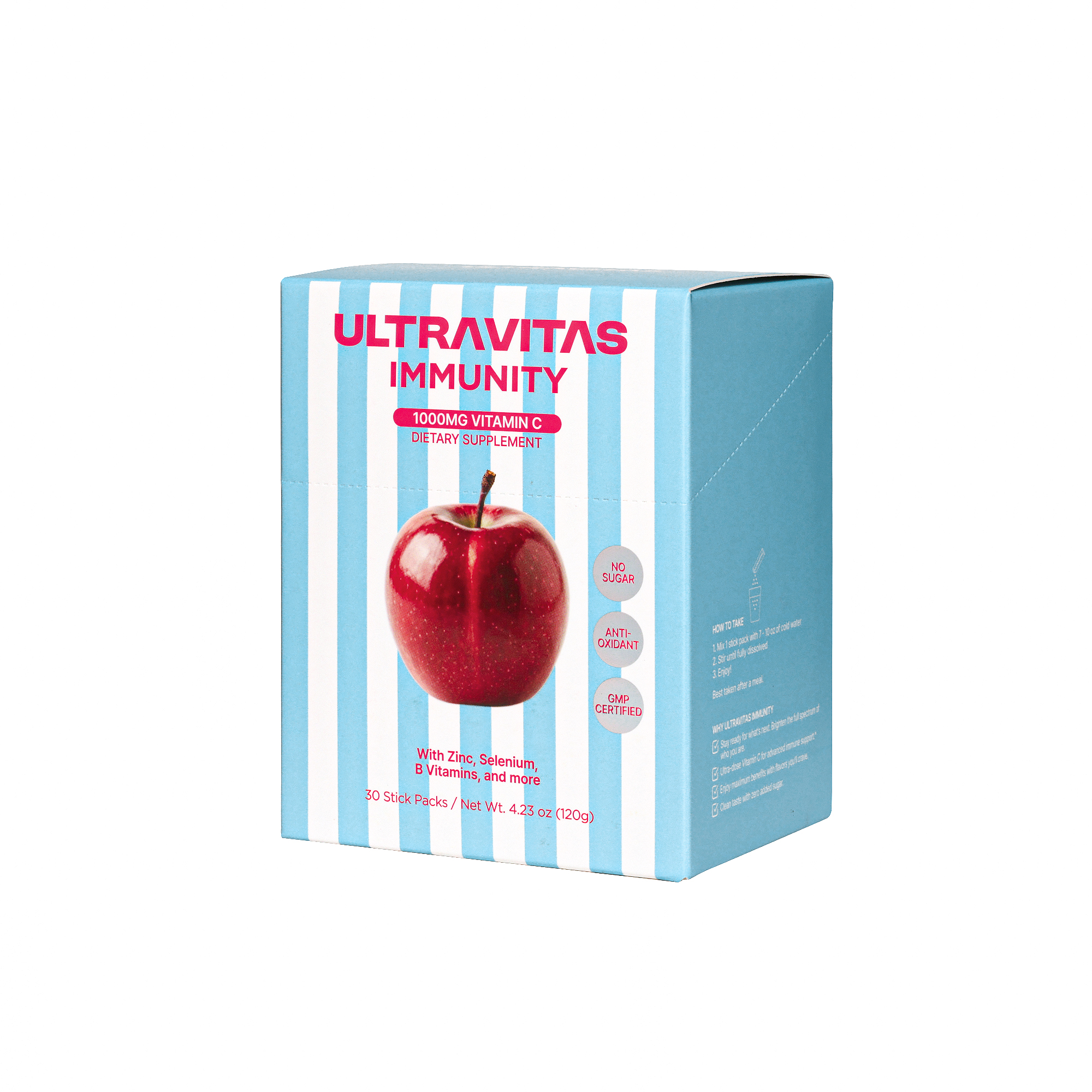
Immunity
Apple
1,000 mg (1,111% DV) Vitamin C
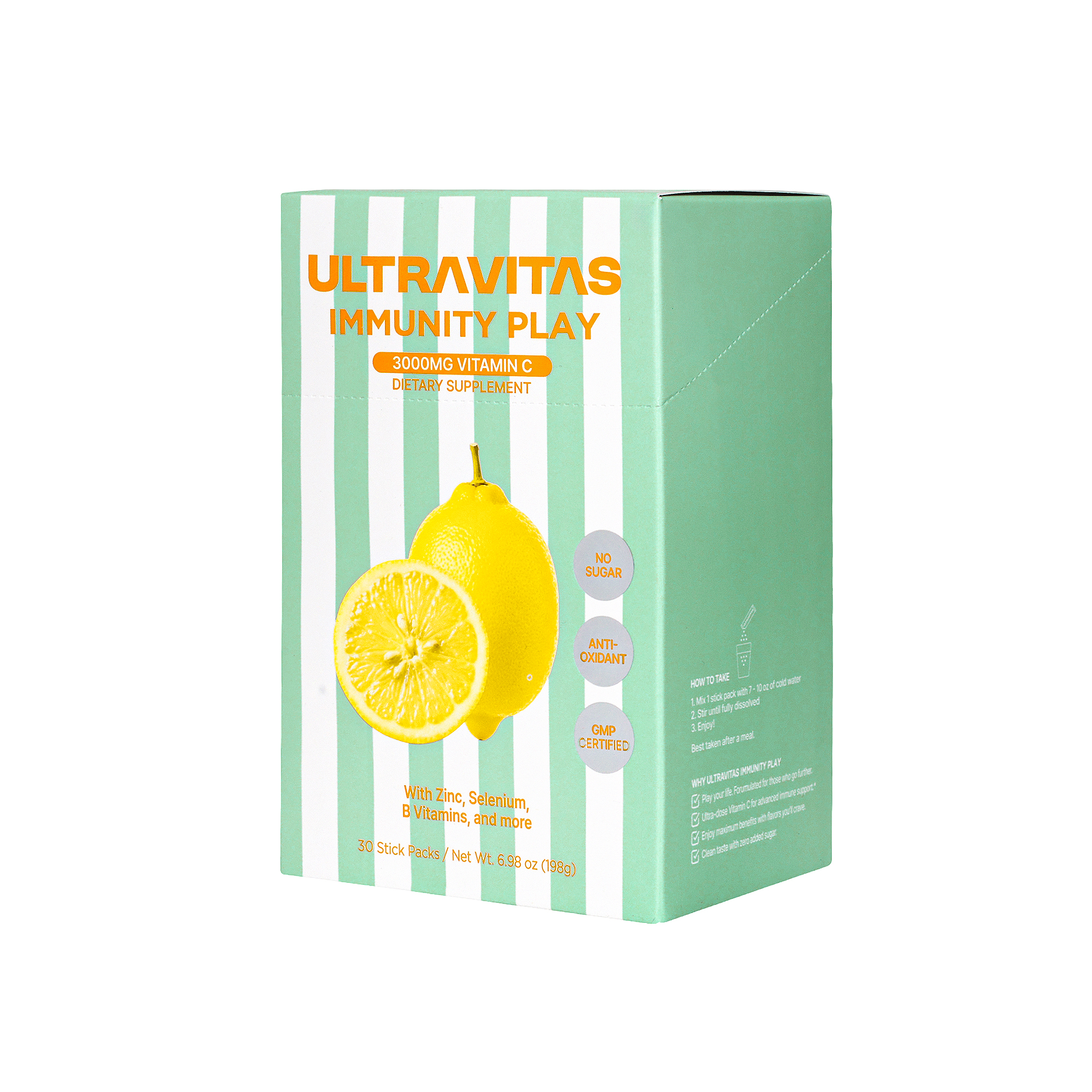
Immunity Play
Lemon
3,000 mg (3,333% DV) Vitamin C
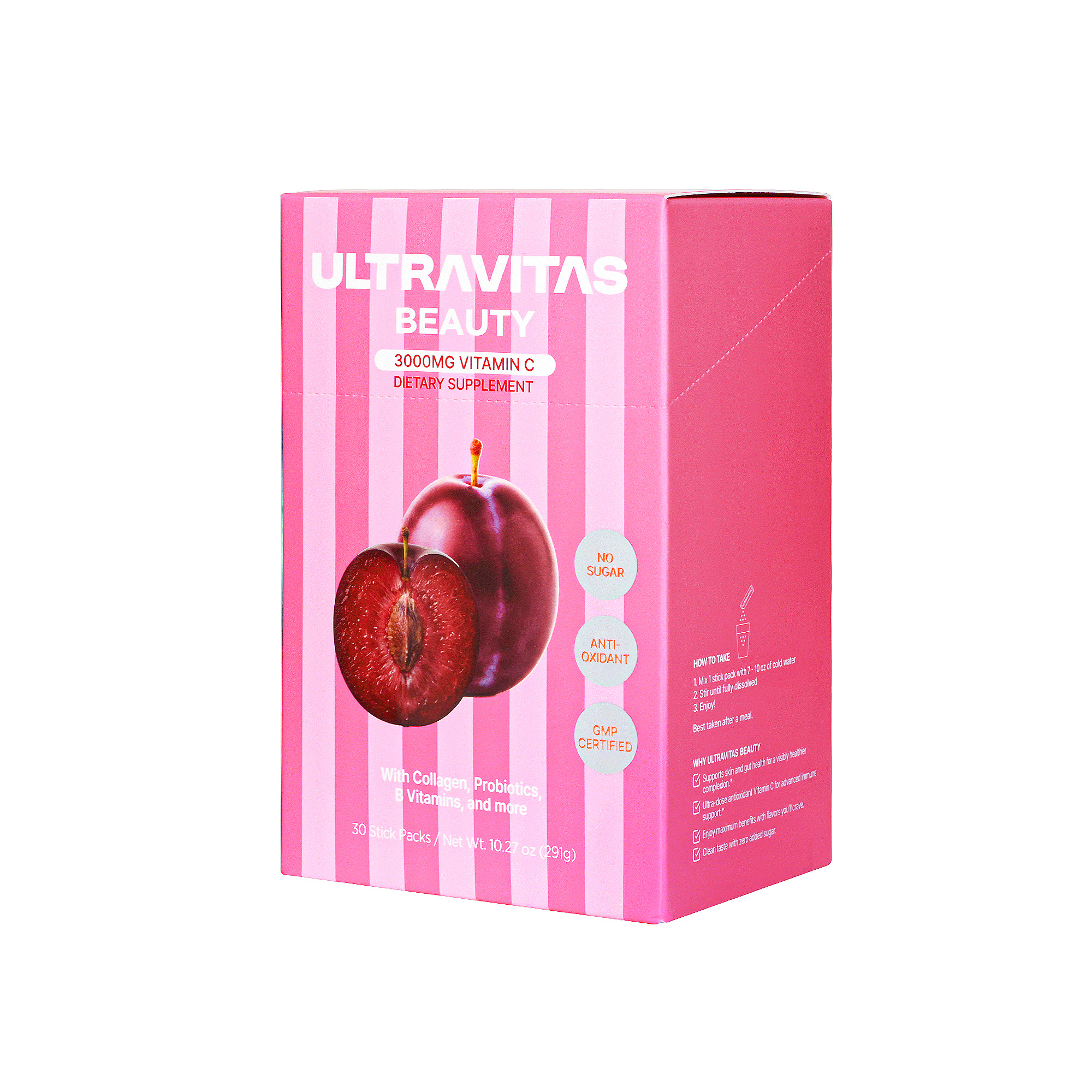
Beauty
Korean Plum
3,000 mg (3,333% DV) Vitamin C
Swipe the table sideways to see all columns.
| Formula | Flavor | Vitamin C | % DV | Also includes |
|---|---|---|---|---|
| Immunity | Apple | 1,000 mg | 1,111% DV | 15 total ingredients |
| Immunity Play | Lemon | 3,000 mg | 3,333% DV | 15 total ingredients |
| Beauty | Korean Plum | 3,000 mg | 3,333% DV | 2,500 mg collagen, 1 billion CFU probiotics, contains fish |
Full Supplement Facts, pack sizes, and pricing are on each product page. Compare all formulas.
Fundamentals
Vitamin C Does More Than Prevent Deficiency
Vitamin C has well-established physiological roles. It:
- is required for collagen biosynthesis
- functions as a physiological antioxidant
- plays an important role in normal immune function*
- improves absorption of nonheme iron
- is an essential nutrient humans cannot synthesize internally
Individual fit
High Potency, Individual Choice
Ultra-dose supplementation is not one-size-fits-all. Individual tolerance, diet, health status, medications, and total nutrient intake can matter. Higher vitamin C intake can cause gastrointestinal effects in some people. People with medical conditions, those taking medications, pregnant or nursing individuals, or anyone uncertain about high-dose supplementation should discuss it with a qualified healthcare professional.
Questions
Ultra-Dose Vitamin C FAQ
More general questions are answered in the UltraVitas FAQ.
Citations
Scientific Sources & Further Reading
- NIH Office of Dietary Supplements. Vitamin C — Fact Sheet for Health Professionals.Physiological roles, RDA, absorption, pharmacokinetics, and general safety context.ods.od.nih.gov
- Institute of Medicine (National Academies). Dietary Reference Intakes for Vitamin C, Vitamin E, Selenium, and Carotenoids — Vitamin C chapter.Derivation and meaning of the 2,000 mg adult UL and its gastrointestinal endpoint.ncbi.nlm.nih.gov
- Levine M, et al. Vitamin C pharmacokinetics in healthy volunteers: evidence for a recommended dietary allowance. PNAS. 1996. PMID: 8623000.Dose–concentration relationship, absorption, tissue saturation, urinary excretion.pubmed.ncbi.nlm.nih.gov
- Padayatty SJ, et al. Vitamin C pharmacokinetics: implications for oral and intravenous use. Annals of Internal Medicine. 2004. PMID: 15068981.Oral pharmacokinetic context.pubmed.ncbi.nlm.nih.gov
- Padayatty SJ, Levine M. Vitamin C: the known and the unknown and Goldilocks. Oral Diseases. 2016. PMID: 26808119.Review context on high oral intake, open scientific questions, and the documented history of gram-level vitamin C use, including Linus Pauling's own reported intake.pubmed.ncbi.nlm.nih.gov
- Nishikimi M, et al. Cloning and chromosomal mapping of the human nonfunctional gene for L-gulono-γ-lactone oxidase, the enzyme for L-ascorbic acid biosynthesis missing in man. J Biol Chem. 1994. PMID: 8158257.Molecular basis for the loss of vitamin C synthesis in humans (non-functional GULO gene).pubmed.ncbi.nlm.nih.gov
- Padayatty SJ, et al. Human adrenal glands secrete vitamin C in response to adrenocorticotrophic hormone. American Journal of Clinical Nutrition. 2007. PMID: 17284737.Observed adrenal vitamin C release during ACTH stimulation in humans.pubmed.ncbi.nlm.nih.gov
- National Academies. Biographical Memoirs — Linus Pauling.Historical account of Pauling's advocacy and long-term personal vitamin C use.nationalacademies.org
- Linus Pauling Institute, Oregon State University. Micronutrient Information Center — Vitamin C.Nuanced context on high oral vitamin C intake, gastrointestinal effects, and populations where caution may be appropriate.lpi.oregonstate.edu
- Report of long-term oral vitamin C intake at gram-level doses. PubMed. PMID: 6717321.Published documentation of daily vitamin C intake around 10 grams.pubmed.ncbi.nlm.nih.gov
Explore the Ultra-Dose Lineup
Go Deeper in the Ultra-Dose Lab
Every published Ultra-Dose Lab story, covering human biology, formulation chemistry, and the questions research is still working through.
- EvolutionHumans Broke Their Vitamin C FactoryMost mammals can make vitamin C. Humans can't. The reason is buried in our evolutionary history.
- Ultra-dose historySome People Take HOW Much Vitamin C?Gram-level vitamin C supplementation has existed for decades, including documented personal use around 10 grams per day. Why?
- AbsorptionYou Took 3,000 mg. Now What?A 3,000 mg serving does not mean 3,000 mg enters your bloodstream. Follow vitamin C through the body.
- PhysiologyWhy Is There So Much Vitamin C in the Adrenal Glands?Vitamin C is not spread evenly through the body. Some tissues hold far more than others — and the adrenal glands are near the top.
- BiochemistryVitamin C + Collagen: It's Chemistry, Not MarketingVitamin C is a required cofactor for the enzyme steps behind normal collagen formation. That is physiology, not a pairing invented by marketers.
- SourcingIs “Natural” Vitamin C Better Than Synthetic?A vitamin C molecule does not know whether it came from an orange or a supplement. Here is what human bioavailability research shows.
- Emerging scienceWhat Happens When Vitamin C Reaches the Gut?Not every milligram of a large oral dose is absorbed in the small intestine. What the rest does downstream is still being studied.
- Taste chemistryWhy Does High-Dose Vitamin C Taste So Sour?Because vitamin C is literally an acid. The fun part is what formulation does with that.
- Dose comparison1,000 mg vs 3,000 mg Vitamin C: What's Actually Different?The obvious answer is 2,000 mg. The useful answer involves absorption, tolerance, and personal preference.
- Format comparisonPowder Sticks vs. Pills, Gummies, and EffervescentsFour ways to take vitamin C, and one practical constraint that decides most of it: how much actually fits in a serving.
- Form comparisonHigh-Dose Ascorbic Acid vs. Liposomal Vitamin CSame molecule, different packaging around it. Here is what the published human evidence currently supports.